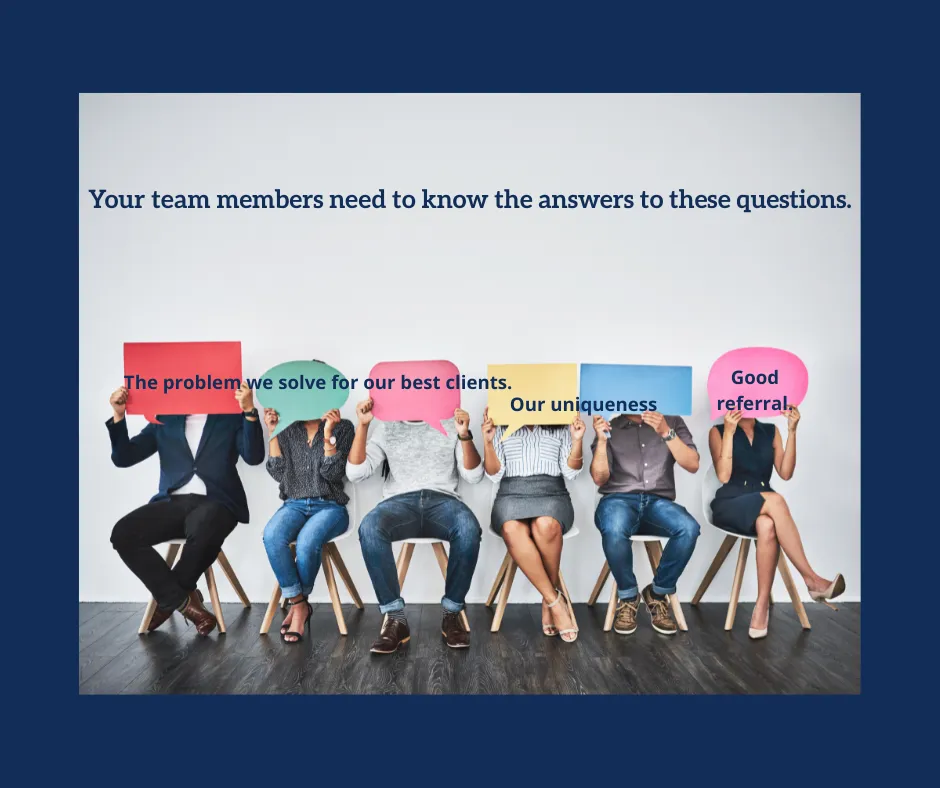
5 Questions Employees Need to Answer About Your Business
Your employees are already talking about your business.
They may be at a community event, a client meeting, a school function, a volunteer project, or a casual conversation with a neighbor when someone asks, “What does your company do?”
I saw this play out recently in one of the monthly workshops I lead, this time with a business owner and two members of his team. As part of the process, each attendee worked through a script for a stronger 60-second introduction: less like a stiff commercial and more like a clear, natural way to explain who they help, what problem they solve, and why someone would want to keep listening.
As we talked through the exercise, the owner paused and said something that stayed with me. He lifted his hand in front of his face and said, “We are this close to our business. We have a hard time seeing it.”
When you are inside the business every day, your value can feel obvious. You know the story, the clients, the headaches you solve, and the difference your team makes. Your employees may use different language, and the people they meet lack the context you carry around in your head.
The founder knows the story. The website has polished language. The sales team may have a strong message. Then someone from accounting, operations, customer service, production, or administration gets asked a simple question and answers from a task instead of the company’s value: “I work in accounting.” “I handle scheduling.” “I’m in operations.”
Those answers may be accurate, yet they rarely create curiosity. A stronger answer helps people understand who the company serves, what problem the company solves, and why the work matters.
1. What does our company do?
This sounds simple, which is why the message often gets fuzzy first.
Many employees describe the company by category: manufacturer, financial firm, service company, contractor, marketing agency. That gives people a starting point, yet rarely gives them a reason to care.
A better answer explains the work in plain language. Instead of saying, “We are a service company,” an employee might say, “We help small businesses keep their equipment running so they can avoid delays and serve their customers on time.”
The goal is clarity, rather than complexity. A useful test is this: could someone repeat the answer to another person after hearing it once?
2. Who do we serve?
When someone says, “We work with everyone,” the listener has no way to recognize a good fit. Everyone is too broad to remember, especially when referrals matter.
Do you serve growing manufacturers, busy families, professional service firms, nonprofit leaders, construction companies, healthcare organizations, local homeowners, or business owners with 5 to 50 employees?
The more specific the answer, the easier it becomes for someone to say, “I know someone like that.” Your business can serve more than one type of client while still giving your team enough direction to recognize the people and organizations you most want to reach.
3. What problem do we solve?
This question helps employees move from describing activities to describing impact. “We process payroll” becomes “We help business owners avoid payroll mistakes and give employees a smoother experience.” “We manage projects” becomes “We keep projects moving so clients have fewer surprises.” “We answer customer calls” becomes “We help customers get answers quickly so small issues stay small.”
“We install systems that help clients reduce downtime.”
The task explains what the employee does. The problem explains why it matters. When employees understand the problem your company solves, they can connect their daily work to the bigger value of the company.
4. Why do clients choose us?
This question gets to the heart of differentiation.
Many companies sound similar from the outside. The words “quality,” “service,” “experience,” and “trusted” appear everywhere. Those words become useful when your team can explain what they look like in real life.
Your team needs examples. Clients may choose you for responsiveness, personal attention, technical expertise, speed, follow-through, niche experience, or your ability to simplify a complicated process.
Instead of saying, “We have great customer service,” they might say, “Clients choose us because we explain the process clearly and respond quickly when something changes.”
Instead of saying, “We are experienced,” they might say, “Clients choose us because we understand the issues that slow projects down.”
Specific language is believable because people can picture what it means.
That clarity builds trust.
5. What kind of referral is valuable?
If employees can describe what the company does and have no clear picture of what kind of opportunity is helpful, referrals stay vague. A good referral answer helps people recognize who to send your way.
“A good referral is a company that has invested in marketing and wants its team to speak about the business with more clarity and confidence.” That last one is mine.
When your team knows what a valuable referral sounds like, they can listen differently, notice opportunities in ordinary conversations, and connect what someone says to what your business solves.
Clarity Creates Confidence
When employees struggle to explain the business, the issue is rarely a lack of caring. Most people want to represent their workplace well. They need language and a structure that helps them answer naturally instead of freezing, rambling, shrinking behind a job title, or saying, “It is hard to explain.”
These five questions create that structure. When your team can answer them, your business message becomes easier to share, your marketing becomes more active, your employees become more confident, and your brand becomes more consistent in everyday conversations.
Start Here
Ask three people on your team these five questions.
Make it conversational and low-pressure. Tell them you are listening for clarity, then notice whether the answers are aligned, specific, natural, curiosity-building, and connected to the value of the business.
If the answers are scattered, that is useful information. It means your team has an opportunity to strengthen the way they talk about the business.
