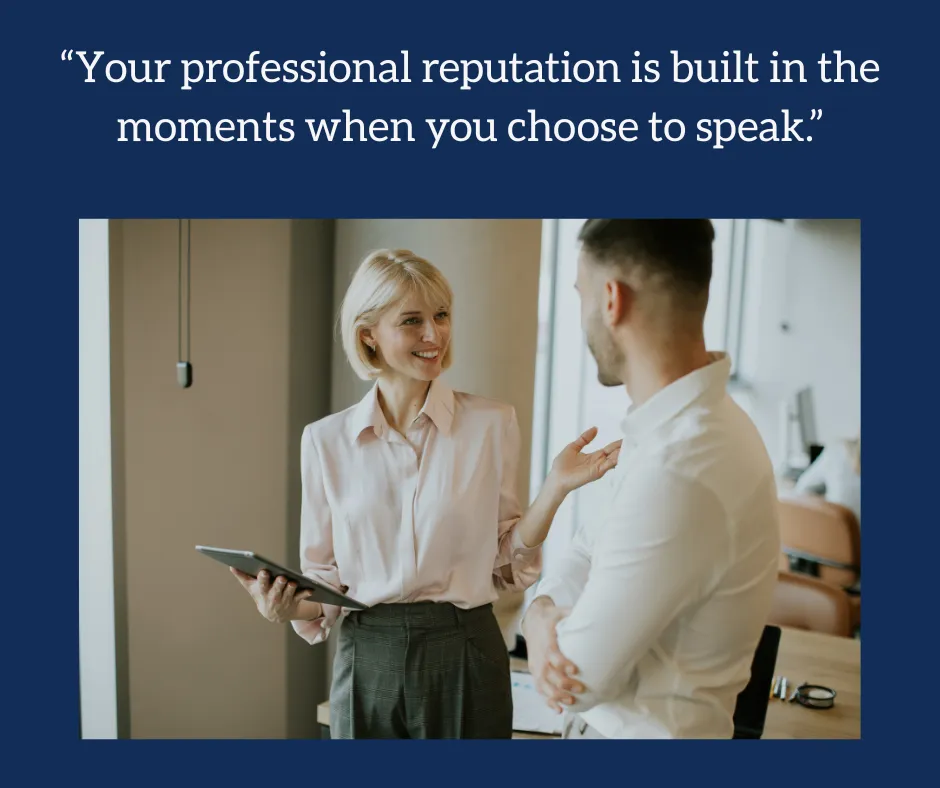
Three Speaking Moments That Shape Your Professional Reputation
Your professional reputation starts in small everyday moments. While the ability to give a formal presentation is important what really matters is about how you show up and contribute to discussions and answer questions with a voice that remains truly yours.
Your Reputation Isn’t Built in a Keynote
Whenever I introduce myself at a networking event, I frequently get a comment like, "Oh, I wish I could do that!" or "Can you just come with me to my next meeting and do my intro for me?"
I always smile back, but internally, I’m thinking that I’ve worked on this for years.
People often assume that speaking success is a personality trait, that you’re either born with that natural inflection and enthusiasm, or you aren’t. Nothing could be further from the truth. This subject came up during my monthly workshop, Creating Your Captivating 60 Second Intro.
One participant was watching the room and admitted that they liked how I used my voice, but they felt like they lacked the ability to come across as enthusiastic or use voice inflection the way I do. It was the perfect moment to share a vital truth, be yourself. Avoid trying to be like or sound like someone else.
Authenticity often speaks louder than perfectly chosen words or forced energy. Your professional reputation isn’t built on being a performer, it’s built in the everyday moments where you choose to share your ideas and contribute your perspective.
In my experience, there are three speaking moments that have a big impact on your professional reputation.
1. Introducing an Idea
This often happens in meetings when someone asks for input or when a conversation opens the door for a new perspective.
You may have an idea that could improve a process, solve a problem, or move a project forward.
But many professionals hesitate. Sometimes they worry that their idea isn’t fully formed. Other times they over-explain because they want to sound thorough.
The challenge is that when we lead with too much information, the main idea can get lost.
Leaders tend to respond best to clarity.
One simple shift is to start with the idea first. For example: “I have a suggestion that can help streamline this process.” Once the idea is clear, you can add supporting details.
Clarity signals confidence, and confidence builds credibility.
2. Answering a Question
Questions are often reputation moments.
Whether it happens during a meeting, a presentation, or a conversation with leadership, people tend to pay close attention when someone is asked to respond on the spot.
The pressure can cause many professionals to speak too quickly, talk too long, or lose focus in their explanation.
One of the most powerful things you can do in this moment is pause.
A brief pause gives your brain a chance to organize your thoughts and signals that you are responding thoughtfully rather than reacting impulsively. Short, clear answers often create a stronger impression than long explanations. When you answer with focus and clarity, people begin to trust both your thinking and your voice.
3. Offering a Different Perspective
I’ve also seen another situation play out many times in corporate meetings.
You’re sitting in a room with colleagues and senior leaders. The discussion is moving quickly and the group seems to be leaning toward one direction.
But something in your experience tells you there may be another perspective worth considering.
You hesitate. Maybe you’re the only one thinking it. Maybe the senior leader in the room has already expressed an opinion. Maybe you’re wondering if it’s your place to speak.
So you stay quiet. Later, as the meeting ends, you think: “I should have said something.”
Most professionals have experienced that moment. Yet when thoughtful perspectives remain unspoken, teams can fall into groupthink where everyone agrees simply because no one wants to challenge the direction of the conversation.
Strong organizations don’t avoid different viewpoints. They benefit from them. And the professionals who learn how to share a thoughtful perspective respectfully especially when the stakes are high are often the ones leaders come to trust most.
Leadership presence isn’t about having the loudest voice in the room. It’s about having the courage to contribute the perspective that moves the conversation forward.
The Skill Behind the Moment
Moments like these may seem small.
Introducing an idea in a meeting.
Answering a question on the spot.
Sharing a different perspective when the room is leaning in another direction.
Over time, these moments shape how people experience your confidence, credibility, and leadership presence. Communication skills aren’t just presentation skills. They’re leadership skills.
That’s why the professionals I work with focus on developing a repeatable approach to showing up and speaking with clarity, in all conversations.
In my 5 S.T.E.P.S.™ to Speaking Success framework, we focus on building both the mindset and the structure behind confident communication.
It starts with summoning your inner champion and tackling the internal obstacles that cause many professionals to hesitate in important moments.
From there, we focus on engaging the room, preparing intentionally, and sharing ideas in ways that connect and resonate.
Because the goal isn’t to sound perfect when you speak. The goal is to show up with the clarity and confidence that allows your expertise to be heard. And often, it’s the everyday speaking moments that make the biggest difference.
Your professional reputation isn’t built in one big presentation. It’s built in the moments when your voice helps move the conversation forward.
If you’d like to have a conversation about your speaking confidence, click here to schedule a call.


