
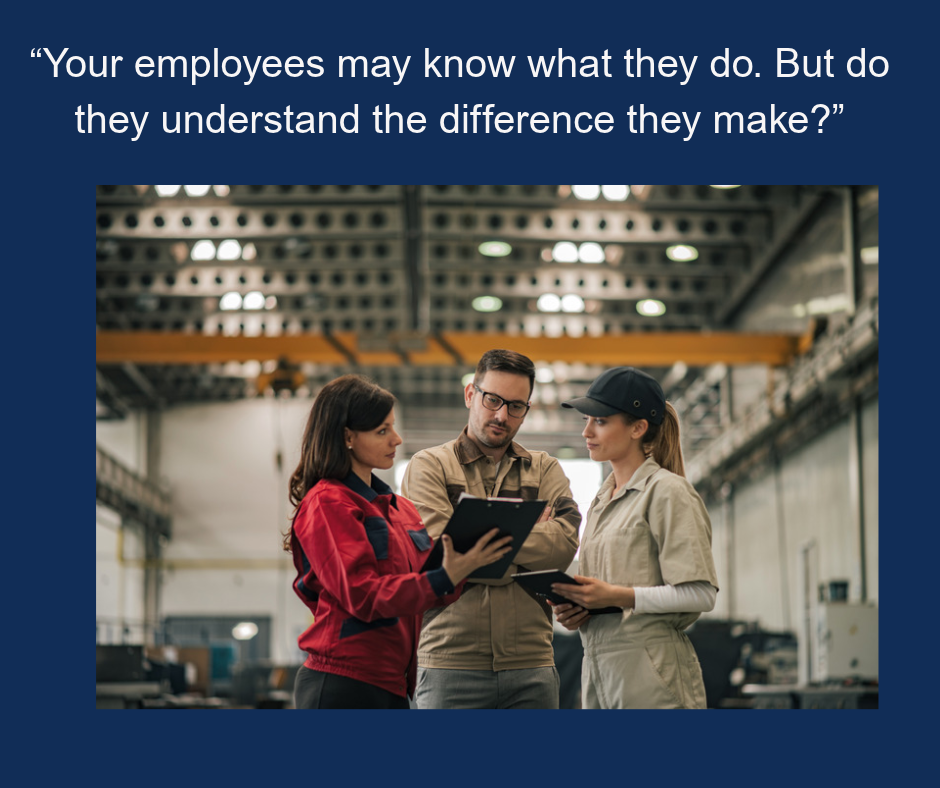
Why developing employee ambassadors starts long before someone talks to a customer.
Earlier this week, I attended the Small Business Association of Michigan's Leadership Council Summit. As often happens at these events, some of the most interesting conversations took place outside the formal sessions.
While talking with another business owner, I shared an observation about communication that I've been thinking about for some time.
The farther an employee gets from the founder of a company, the more likely they are to describe their work by their job title rather than by the value their company provides.
Think about that for a moment.
The founder might enthusiastically explain why they started the business, the problems they solve, and what makes their organization different.
An employee might simply say, "I'm a production supervisor," "I work in accounting," or "I'm a machine operator."
There's nothing wrong with those answers. They're accurate.
But they miss an opportunity to start a conversation about the value behind the work.
The business owner I was speaking with immediately recognized the distinction. She loved how specific my focus was.
Another business owner, who operates a metalworking plant, shared a related challenge: Her production employees don't necessarily understand the value of the work they do every day.
And another person introduced a word that captured an important part of the conversation: ambassador.
That word stuck with me.
Your Employees Are Already Representing Your Business
Whether they realize it or not, your employees are ambassadors for your organization.
They represent your business when they're talking with customers, attending community events, meeting potential employees, or answering a neighbor's question about where they work.
But here's what I wonder:
Have we equipped them to communicate the value of the business they're representing?
Consider an employee who works in manufacturing.
They might say, "I operate a CNC machine."
That's their job.
But imagine if they understood how the precision components they produce contribute to the customer's success.
Their answer might become, "I help manufacture precision parts that our customers depend on to keep their operations running."
The second response communicates something the first doesn't: purpose and value.
It also creates an opportunity for a conversation.
The employee hasn't become a salesperson. They've simply developed a deeper understanding of the difference their work makes.
The Communication Gap That Grows with Your Business
When a company is small, employees often work closely with the founder. They hear customer stories, understand the company's challenges, and see firsthand how their work makes a difference.
As the organization grows, those connections can weaken.
Departments become more specialized. Employees focus on their individual responsibilities. Supervisors concentrate on production goals, deadlines, and daily operations.
Somewhere along the way, the connection between what we do and why it matters can get lost.
And when employees don't understand that connection, how can we expect them to communicate it?
This isn't necessarily an employee problem.
It's a leadership communication opportunity.