
Have you ever been in a meeting where the person with the most knowledge wasn't the person who made the greatest impact?
Perhaps they shared all the facts, explained the details, and answered every question.
Yet when the meeting ended, people were still unclear about what they were supposed to do with the information.
The problem wasn't a lack of expertise. It was a disconnect between what the speaker knew and what the audience needed to understand.
And that happens more often than we realize.
When You Need More Than Expertise
A few months ago, I worked with an experienced business professional who was preparing to present to approximately 75 business owners and managers at an industry conference.
She knew her material. She understood the industry. In fact, she'd been invited back to speak at this event several times.
So why was she working with a presentation coach?
Because she recognized that knowing your material and communicating it effectively are two different skills.
During our first conversation, she made an interesting observation.
When facilitating a small group, she could read people's expressions, recognize confusion, and adjust her approach. How could she do that in a much larger audience?
That's where our work began.
It's More Than How Much You Know
As we reviewed her presentation, we kept coming back to a few important questions.
What does this particular audience need to understand?
Which examples will make the information meaningful to them?
Where can we create opportunities for people to participate rather than simply listen?
And perhaps most importantly, what information can we leave out?
At one point, we reviewed a slide containing quite a bit of detail.
The information was valuable, yet putting it all on the screen would require her audience to read while she was speaking.
We decided that information would be more useful as a handout.
The expertise didn't disappear. We simply changed how it would be delivered.
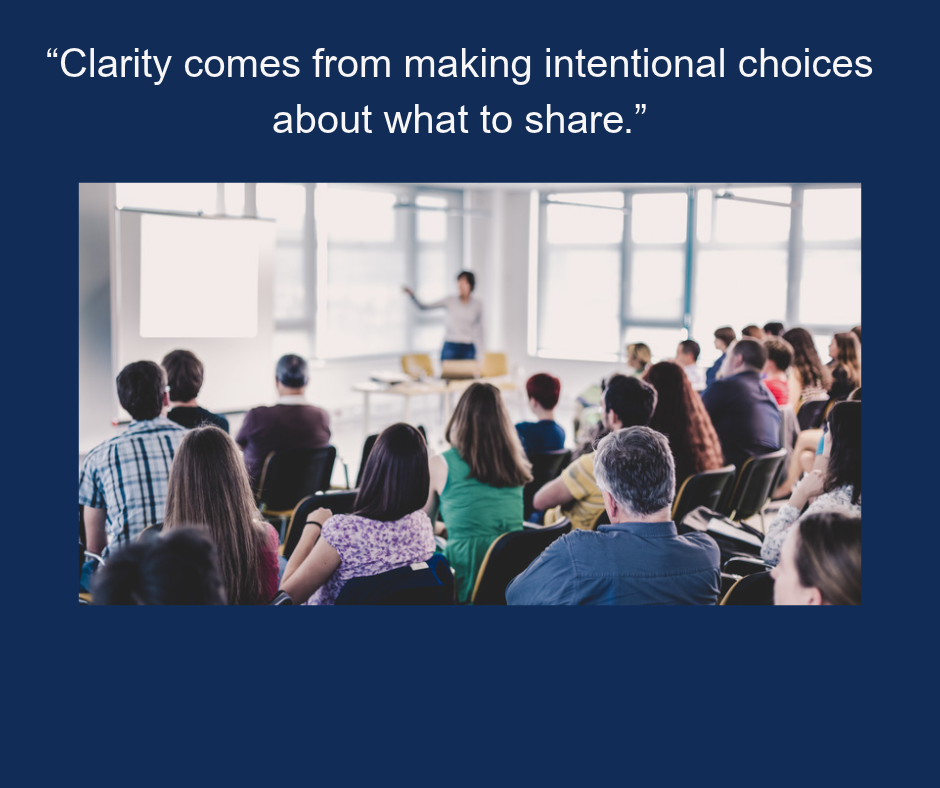
Clarity isn't about knowing less. It's about making intentional choices about what to share.
The Audience Is Part of the Equation
One of the things I encouraged her to do was to build the presentation as way to hold a conversation with this group.
She was already skilled at facilitating conversations. We wanted to build on that strength rather than turn her into someone she wasn't. Plus, she used examples and visuals that reflected the world her audience worked in every day.
A generic business image might look professional, but would it resonate with someone who spends their day managing a production facility? Probably not as well as something directly related to their work. That may sound like a small detail, but it's an important principle.
Effective communication is more than what you want to say. It's about what your audience needs to hear.
And this matters well beyond formal presentations. Do you fall into one of these categories?
the technical expert explaining a recommendation to senior leadership.
the department manager providing a project update.
the business owner explaining a new direction to employees.
In each situation, the ability to communicate clearly influences whether people understand the message and know what to do next.
Three Questions to Ask Before Your Next Important Conversation
Whether you're presenting to a roomful of people, leading a staff meeting, or explaining a recommendation to a client, consider these three questions.
1. What's the one thing I want my audience to understand?
If you can't identify your central message, your audience will have a difficult time finding it.
Before preparing your slides or organizing your talking points, complete this sentence:
"If my audience remembers only one thing, I want it to be..."
Build your message around that answer.
2. Why should this matter to them?
Your audience may not share your knowledge, priorities, or experience.
The details you find fascinating may not be what they need to make a decision.
Connect your message to something they care about: a challenge they're facing, a decision they need to make, or an outcome they want to achieve.
Remember, your audience is listening for what's relevant to them, not necessarily what's most interesting to you.
3. What do I want them to do with this information?
Information alone doesn't create impact.
Maybe you want people to consider a new approach, change a process, ask better questions, or make a decision.
Make that next step clear.
Don't assume your audience will automatically know what you want them to do.
Your Expertise Deserves to Make an Impact
The best expert in the room isn't always the person who gets heard.
Sometimes it's the person who makes complicated information understandable.
The person who connects the dots.
The person who knows when to share the details and when to get to the point.
You don't necessarily need to know more to communicate more effectively.
You need to become more intentional about how you share what you already know.
Because your expertise creates real value when people understand it well enough to act.
Let's Continue the Conversation
Think about the meetings and presentations taking place in your organization.
Are people simply sharing information, or are they communicating in ways that lead to understanding and action?
If your team has the expertise but struggles to communicate it clearly, let's have a conversation about what could change. Click here to book a conversation.